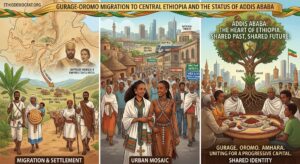
 Addis Ababa: This piece dissects the historic migration of the Gurages and the Oromos from the 13-16 centuries in the context of the current dialogue about Addis Ababa.
To walk the crowded, sunny streets of Addis Ababa is to witness a city in a constant state of becoming. In the Merkato, the continent’s largest open-air market, the air is thick with the scent of berbere and the cacophony of a dozen different dialects. Here, the Gurage, the Amhara, and the Oromo do not just coexist; they are the composite parts of a single urban engine. But as Ethiopia grapples with its future, a volatile question has begun to echo through its corridors of power and its social media feeds: To whom does the land truly belong?.
In recent years, the push toward ethnic federalism as promoted by TPLF has seen various groups claim exclusive ownership over specific territories, treating the capital and its surrounding regions as spoils of a historical contest. Yet, to look at Ethiopia as a collection of separate ethnic islands is to fundamentally misread the history of the land. This is not a nation of static groups sitting on ancestral plots; it is a grand tapestry of movement and mixing, defined by two massive migrations that crisscrossed the plateau and forever blurred the lines of identity.
The Northern Soldiers: The Genesis of the Gurage
The first of these defining movements was a southward descent that began not with farmers, but with soldiers. Centuries ago, the ancient Kingdom of Aksum in the north served as the cradle of Ethiopian civilization. As the power of the northern Christian kings expanded, they sought to secure their southern frontier.
Historical records, supported by the work of Paul Henze, reveal that monarchs like Amda Seyon in the early 1300s began deploying soldier colonies into the hills southwest of what is now Addis Ababa. These outposts were intended to be permanent anchors of imperial influence. By the 15th century, during the reigns of Zara Yaqob and Dawit, these settlements were formalized. Cut off from their northern roots by geography and time, these soldiers eventually evolved into the Gurage people, developing a distinct culture that was never a “pure” northern extraction but a fusion of newcomers and indigenous groups, such as the ancient Harla. The Gurages were eventually pushed further south from what is now Addis Abeba by the massive Oromo migration.
The Southern Surge: The Oromo Expansion
While the ancestors of the Gurage were settling in from the north, a second, even more transformative movement was gathering strength in the south. The Oromo people, currently the largest ethnic group in Ethiopia, making up more than one-third of the population, began a northward and outward expansion in the 16th century that would fundamentally redraw the map of the Horn of Africa.
The catalyst for their expansion was a devastating vacuum. In the 1520s and 1530s, the Christian empire and the Muslim state of Adal, led by Imam Ahmad (Gragn), engaged in an exhaustive, scorched-earth war. The conflict left the borderlands decimated and depopulated. As the two warring states collapsed under the weight of their own violence, the Oromo moved into the open space.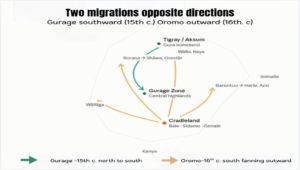
This was not a simple conquest, but a massive demographic shift. The monk Bahrey, writing in 1593, documented with astonishment how a herding people had spread across half the empire in a single lifetime. The expansion followed a clear, two-pronged strategy: the Barentu branch moved east and northeast into Arsi, Harar, and as far north as Tigray, now Eritrea; meanwhile, the Borana branch pushed northwest into Shewa, Gojjam, and Gondar.
The Oromo did not just occupy land; either they eliminated any opposition, or they absorbed the people they encountered. Through the custom of gudifacha, a form of formal adoption, outsiders were integrated as family members, allowing the Oromo to grow exponentially in number and influence as they moved. This was a process of radical integration, turning a regional group into a national pillar.
The Collision in the Center
These two great historical currents—the northern soldiers moving south and the southern herders moving north—inevitably met in the center of the country. In the hills of Shewa, the children of these two movements became neighbors.
The migration accounts reveal a complex friction. For instance, Gurage groups that had initially settled near Sebeta, southwest of the modern capital, were pushed further south into the highlands as the Oromo expansion pressed into central Shewa. This was not a story of total displacement, but of demographic layering. The pattern of these migrations proves that Ethiopia’s regional names are not markers of eternal, exclusive ownership; they are merely the places where centuries of movement finally paused.
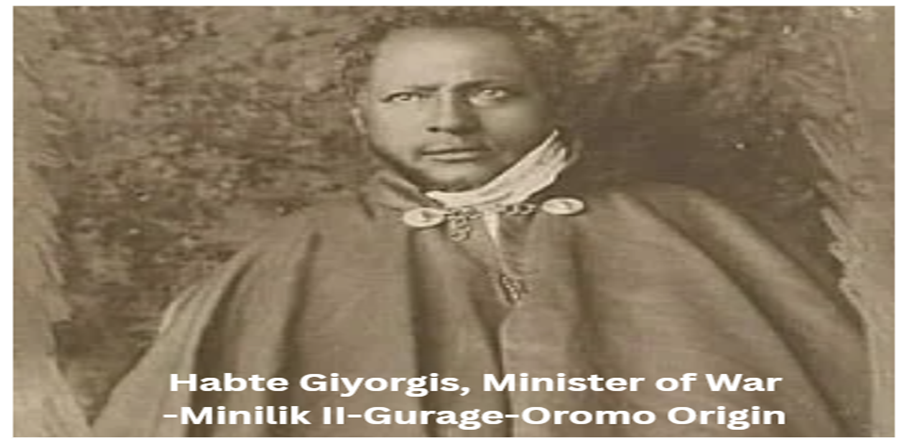
The most potent symbol of this synthesis is found in the history of the nation’s elite. Consider Fitawrari Habte Giyorgis Dinagde, the legendary Minister of War under Emperor Menelik II. A man of immense power, he was born of both Gurage and Oromo lineages. In his time, a leader of mixed heritage was not seen as a contradiction, but as a reflection of the nation’s blended reality.
The Peril of the “Owner-Guest” Narrative
Despite this history of profound mixing, modern political rhetoric in Ethiopia has increasingly turned toward a dangerous “owner-versus-guest” framework. When a territory is tied to a single ethnic name, it sends an implicit message to every other resident: you are a guest, a temporary inhabitant whose rights are conditional.
This mindset is a reversal of history. The land was never the domain of one group alone; it was a shared space where people moved, married, and traded for generations. When this reality is ignored in favor of walled-off ethnic zones, the social fabric begins to fray. Trust evaporates, businesses flee, and neighbors who have lived side-by-side for decades are suddenly recast as rivals.
A modern metropolis like Addis Ababa—much like London, New York, or Toronto thrives because it belongs to all who live within it. In those global hubs, a leader is chosen for his ability, not his bloodline; London or New York, cities that are not majority Muslim, chose Muslim mayors because the voters prioritized the person over the identity.
If Ethiopia is to survive as a unified state, it must embrace its history as a woven nation rather than a collection of separate islands. The Afars, Tigres, Wolaitas, Oromos, Hadyas, Amharas, Gurages, and other groups did not build this proud nation alone, but instead created it together by moving around, sharing values, and living side by side for centuries. To forget this is to put the future of the nation and the lives of people at risk and destroy this great city and nation.
Abdissa A. Malik