Nov 28, 2026 · @Hager
In most countries, when people are angry at their government, they march. They write. They go to court. They organize, boycott, engage in work stoppage, register voters, and throw the bad leaders out at the next election. In Ethiopia, too often, they pick up a rifle and head for the bush. That single difference may explain more about our country’s endless suffering than any other fact of our history.
As this is written, Ethiopia is once again at war with itself. Since late September 2026, fighting has spread from Tigray into Amhara and Afar. Seven armed groups, including the TPLF, the Oromo Liberation Army and the Amhara Fano National Movement, have announced an alliance whose stated aim is to overthrow the federal government. The army is conducting drone strikes in its own country, and there are reports of forced conscription in Oromia and Addis Ababa. Barely four years after the Pretoria agreement ended a war that killed hundreds of thousands, we are back where we started.
We have to ask an uncomfortable question: why is it so easy for Ethiopians to kill one another?
The Foreign Hand Is Real — But It Needs Our Hands
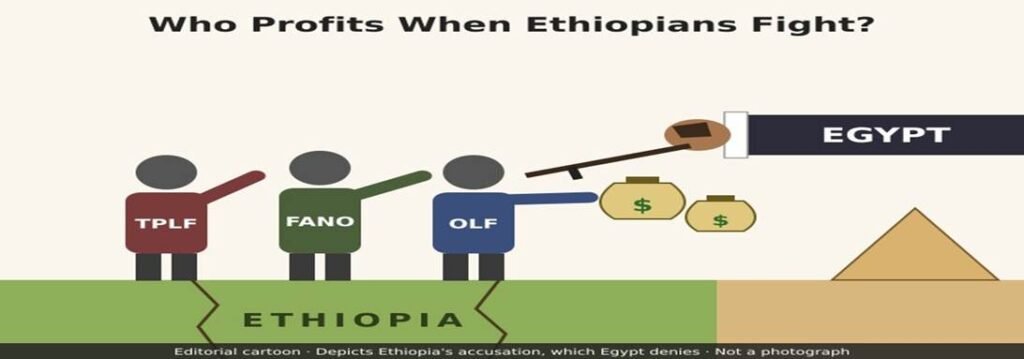
Editorial cartoon. It illustrates the Ethiopian government’s accusation that Egypt arms these groups.
Ethiopia’s enemies are not imaginary. Egypt has spent more than a decade opposing the Grand Ethiopian Renaissance Dam, which Cairo sees as a threat to its share of the Nile. A weak, divided Ethiopia that cannot build, cannot govern its regions and cannot speak with one voice at the negotiating table serves that interest perfectly.
In September and again in November 2026, Ethiopia’s army chief, Field Marshal Birhanu Jula, accused Eritrea of organizing the rebel coalition and accused Egypt and Sudan of supplying it. Egypt, Eritrea and Sudan all deny this. But the pattern of history is clear: from the Ottoman-Egyptian invasions of the nineteenth century to Cairo’s support for insurgent movements in the Horn during the twentieth, outside powers have long seen Ethiopia’s internal divisions as an opportunity.
Here is the point, however. A foreign power can send money and weapons. It cannot send fighters willing to kill their own neighbors. That part we supply ourselves. If no Ethiopian were willing to take a foreign-funded rifle and turn it on another Ethiopian, Egyptian machinations would be worth nothing. Every armed group that takes outside help, whatever its grievance, becomes a tool in someone else’s strategy — and that strategy is to keep Ethiopia on its knees. It does not mean that there will not be rebellion without outside help, the problem in Ethiopia is the ease, the frequency and the prevalence of such rebellion that fueled by our enemies.
Rebellion Has Become a Business
Look honestly at how armed movements in Ethiopia work. For a young man with no job, no land and no prospects, an armed group offers food, a salary, a gun, status and a cause. For a frustrated politician who cannot win votes, it offers leverage. For commanders, it offers control over roads, checkpoints, taxes, smuggling and ransom. Rebellion has become a franchise for the dissatisfied and an employer for the unemployed.
And like any business, it has a product. That product is instability. The armed movement does not need to win the hearts of the people; it only needs to make governing impossible until someone offers it a share of power. Ask what most of these groups actually propose for the Ethiopian farmer, the student, the trader. Very often the answer is nothing beyond taking power for themselves. Changing who sits in the palace is not the same as changing how Ethiopians live.
Meanwhile, when life gets hard, too many young people stop school and go to the front instead of doing the slow work of organizing for change. Violence looks like a shortcut. It is not. It is a dead end that the whole nation walks down together. In 2025-2018, Ethiopians were able to drive EPRDF out of power peacefully.
What Other Nations Do Instead
Americans who oppose their leaders do not form militias and seize highways. They say “organize, organize” — they build coalitions, flood the streets in peaceful protest, fund candidates, file lawsuits, and turn out to vote. This is not to compare the US with Ethiopia, but when support is overwhelming, no one can resist it, because the change has the legitimacy of millions behind it.
Ethiopians have done this before. The mass protests of 2015 to 2018 in Oromia, Amhara, in the South, especially in the Gurage zone led largely by young people through strikes, boycotts and demonstrations, forced Prime Minister Hailemariam Desalegn to resign and opened the door to political change. That movement was not perfect, and it was met with brutal repression, but it showed something important: organized, mass civic pressure can move even an entrenched ruling party. No rebel army was needed to bring down that government.
The Price We All Pay
Every bullet fired between Ethiopians is a bullet paid for with the nation’s future. The human capital, money, time and resources that should build schools, clinics, roads and businesses are poured into destroying one another. Farms are abandoned. Factories close. Roads to the Djibouti corridor, through which almost all of our trade flows, become battlefields.
Tourists stay away. Investors stay away. Even Ethiopians in the diaspora, who love their country, invest their savings in America, Europe or the Gulf instead of at home, because they know that at the end of the day their money and their families are safe there. Here, the risk is simply too high. Even before this new war, the World Bank estimated that 43 percent of Ethiopians live in poverty. War guarantees that number will not fall.
Yes, the System Is Broken — Fix It Without Guns
None of this means Ethiopia’s government is innocent. There is too much corruption. There is no real rule of law. Property rights are weak. The press is constrained, opposition figures are jailed, and the June 2026 election, which gave the ruling Prosperity Party about 90 percent of contested seats, was held amid a crackdown on dissent while Tigray was excluded and parts of Amhara and Oromia could not vote. Critics argue, with reason, that when peaceful avenues are closed, people feel pushed toward arms.
But that is precisely why the armed path fails. War hands the state its best excuse to stay authoritarian. Every insurgency justifies more emergency rule, more surveillance, more soldiers and less freedom. Violence does not open political space; it shuts it. The groups at war today are not fighting for an independent judiciary, a free press or secure property rights for every citizen. They are fighting for power.
The real battles Ethiopia needs to win are different:
- Rule of law — courts that the powerful cannot bend.
- Property rights — so farmers and entrepreneurs can own, borrow, build and pass on what they create.
- Economic reform — jobs for the millions of young people who are now recruited into militias.
- Real democracy — elections that every region takes part in, and a government that can be voted out.
These are won with pens, petitions, courtrooms, peaceful demonstrations, civil disobedience, independent media and, above all, mass organization ahead of elections regardless of ethnicity. If Ethiopians across every ethnic group rally behind candidates who stand for these reforms, with support as overwhelming as a landslide, it becomes very hard for anyone to steal or ignore the result.
Stop Serving Our Enemies
The choice before Ethiopians is not between this government and that rebel army. It is between a country that settles its disputes through argument and votes, and a country that settles them through blood — and stays poor, divided and vulnerable forever.
Every Ethiopian who refuses to pick up a gun against a fellow Ethiopian is defeating the strategy of those who want us weak. Let us stop killing each other for the benefit of outside powers. Let us demand reform loudly, peacefully and together like the one brought down the EPRDF regime in 2018. Let us organize, speak, write and vote. There is a chance for peace. There is a chance for reform. There is a chance for democracy. Why not work for it, instead of serving our enemies and making life miserable for our own people?