Archive for the ‘Uncategorized’ Category

Ethiopia: A country Built on Sand

Tuesday, February 3rd, 2026

This article discusses how an ethnic-based federation has destroyed national identity and economic prosperity. Since the Tigray People’s Liberation Front (TPLF) introduced ethnic federalism, Ethiopia has operated under a pernicious principle: “Oromo First, Amhara First, Tigre First, Somali First.” This ethnic cancer is slowly destroying the country. Ethiopian identity exists only as a cover for extracting benefits or fulfilling bureaucratic obligations. National identity has been subsumed by ethnic allegiance.   Countries with characteristics or constructed like Ethiopia never last long enough to see daylight.

The current conflict in Welkite, the conflict with FANO, many other killings and displacements, and the war between TPLF and the Federal government in November 2020 are primarily ethnic driven and the result of the TPLF constitution. Ethiopia’s landlocked status was facilitated by TPLF. This shows the decline of nationalism and the rise of individuals driven by hatred towards Ethiopia and ethnic interests. TPLF assumed that it could align itself with Eritrea and that making Ethiopia landlocked was no concern. After more than 30 years of conflict, divide and rule, killing, and displacement, the Ethiopian people are yearning for sustainable peace and economic development.

 The Foundation Metaphor

The system invites destabilization. External enemies understand this vulnerability. Egypt and Eritrea manipulate Ethiopia’s ethnic fault lines with ease. Ethiopia operates as a plaything for regional powers because its constitutional structure stands against national interest. Historical enemies use this leverage all the time. Ethiopia, despite being endowed with so many resources and people, is being played like a toy or at the mercy of Egypt, Eritrea, even tiny Djibouti, and others because of these factors.

Disintegration or Continuity

Ethiopia has a similar characteristic to countries that eventually implode and disintegrate, and the shiny objects built with the sweet and labor or borrowed money get destroyed. Countries that lack national identity or are assembled using religious factions, like Lebanon, or countries assembled using ethnicity or nationalities, such as the Soviet Union, Yugoslavia, Czechoslovakia, like Ethiopia, disintegrate. Since the introduction of ethnic federation by TPLF, the mantra or the motto is Oromo First, Amhara First, Tigre First, Somali First. This continues to overshadow Ethiopian identity.

In his Seminal book “Wax & Gold”, Donald Levine talked about Ethiopian mendacity, or their willingness to pretend to be Amharas, Tigres, whoever is ruling at the time, to fit or survive, with identity switching. This psychological harm is only inflicted in Ethiopia by the system. The psychological damage is tremendous and a constant threat to the well-being of all Ethiopians. The economic damage is even more serious, as it has the potential to retard the flow of investment and knowledge. Constant conflicts, policy paralysis, and corruption are symptomatic of ethnic federalism.

Article 39 of Ethiopia’s constitution grants every ethnic group the right to secession. Ethiopia stands alone among nations in codifying its own potential dissolution. Friends and foes like Uganda’s Museveni, Rwanda’s Kagame, and even Eritrea’s Isaias Afwerki—have advised against such constitutional suicide. Yet Ethiopia persists with a structure designed for fragmentation rather than unity, despite the lesson from failed states.

Economic and Tourism Loss: Morocco as a mirror:

I was fortunate enough to be in Morocco during the Africa Cup of Nations (AFCON) with my family. It is not about the games that I want to talk about, but Morocco itself. Ethiopia and Morocco have similar cultural and geographic characteristics, except that Ethiopia has a longer history and more internationally recognized monuments. Despite that, Morocco’s per capita income is several times higher, $5150 compared to $1070 for Ethiopia. In 2025, Morocco attracted close to 20 million tourists, generating nearly $14 billion; in contrast, Ethiopia’s tourism receipts was a tiny $1.1 billion.

Ethiopia’s Tourism Goldmine —Underperforming
Ethiopia sits in one of the most extraordinary tourism value propositions: unparalleled antiquity, millennia-old civilizations, dramatic landscapes, and climates ranging from alpine to semi-tropical. Lalibela’s rock-hewn churches, the towering obelisks of Aksum, the imperial palaces of Gondar, and the birthplace of Lucy — the oldest known Homo sapiens ancestor — not only represent deep historical value but global brand recognition that most countries spend billions to buy. Yet Ethiopia’s tourism sector generates a fraction of its potential. Contrast that with North African and Middle Eastern peers, and the gap is not just striking — it’s economically damaging.

Another factor I observed was that Moroccans have astrong sense of nationalism and security. They carry their flags proudly, women can move around day or night at any corner of the country without fear, and children play freely on the streets or in the parks. The police are present in strategic areas, and instead of being feared, they are respected and seen as protectors of peace. Tourism requires security. Investors demand stability. Neither exists under ethnic federalism. Morocco chose national unity. Ethiopia chose ethnic division. Morocco attracts development, Ethiopia attracts conflict. The picture shows Singer Jassar kissing the Moroccan flag.

Ethiopia’s resources and population should command regional respect. Instead, the nation endures constant humiliation because ethnic federalism has made it ungovernable and weak. External forces do not need to invade. They simply need to fund the ethnic faction most opposed to the current leadership and watch Ethiopia tear itself apart.

The Path Forward: Constitutional Reform or National Dissolution

Ethiopia stands at a critical point. The nation can either reform its constitutional structure or accept gradual disintegration. Any other assumption defies all historical evidence. There is no middle ground. Ethnic federalism will destroy Ethiopia just as surely as it destroyed other nations.

First, Article 39 must be abolished. No nation can survive with constitutional provisions for its own dissolution. Granting secession rights to ethnic groups guarantees perpetual instability as factions position themselves for potential independence. Unity requires commitment, not escape clauses.

Dismemberment or divorce by consent, as we seen in the former Soviet Union, or by force, like we have seen in Somalia, is messy. It’s not worth contemplating as the already misery index of Ethiopians would be much higher.The Urgent Call to Action: The nightmare TPLF initiated must end now. Every day, ethnic federalism weakens national bonds and strengthens ethnic identity. Morocco’s success demonstrates what unified nations can achieve. Ethiopia can choose the path of national renewal or continue toward fragmentation. The nation possesses every resource necessary for prosperity except political will for unity. Without constitutional reform that abolishes ethnic federalism and rebuilds national identity, Ethiopia will join the Soviet Union, Yugoslavia, and Czechoslovakia in the graveyard


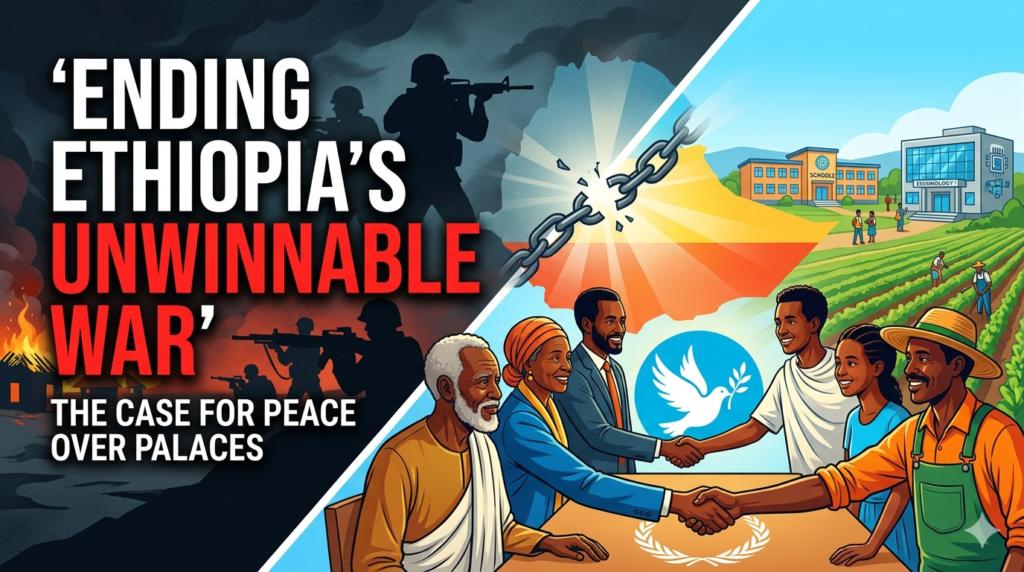
Ending Ethiopia’s Unwinnable and Unnecessary War
Monday, October 28th, 2024

The people of Ethiopia face dire economic hardships, compounded by abject poverty, limited access to technology, and ongoing food insecurity, making peace an urgent necessity. According to recent UN findings, nearly 68% of Ethiopians live in poverty and are unable to meet daily sustenance needs. Amid these significant internal challenges, Ethiopia faces the looming threat of conflict with neighboring nations, leaving little room to waste resources on  unnecessary internal conflicts. Today, the call to prioritize national unity and economic resilience over military pursuits has never been more pressing.

The ongoing war in the Amhara region is both unwinnable and unnecessary. The Fanos don’t threaten the Abiy regime if resolved peacefully. What’s needed is not force but dialogue, fair representation, and free elections, which can address long-standing grievances and give voice to all groups in a peaceful, democratic manner. True, certain groups—like the Fano if the conflict is resolved peacefully—might gain representation in parliament. Yet, they would remain in the minority and not pose a significant threat to the sitting government. However, their inclusion would strengthen Ethiopia’s democracy by ensuring that all voices have a place in the governing body. By ending hostilities and pursuing fair elections in the Amhara region, Ethiopia can avoid the destructive path of fragmentation and preserve its unity.

The Pretoria Peace Agreement ended the conflict in Tigray by giving the Tigray people a chance for local governance and electing their representatives. The same opportunity should be given to the Amhara people or region without delay and end the conflict.

If the war continues, Ethiopia risks weakening itself to vulnerability, inviting potential external threats and disintegration. The longer the conflict endures, the more the divisions among Ethiopia’s ethnic groups widen, endangering the country’s stability and sovereignty. The consequences of further fracture could devastate Ethiopia’s economy, security, and social fabric and threaten the survival of the country and millions who depend on every ounce of national resources to improve their lives.

Call to Action: Unite for Peace and Prosperity

We call on all Ethiopians and the international community to stand in solidarity against this unnecessary conflict. Demand an immediate cessation of hostilities in the Amhara region. advocate for free and fair elections that provide all ethnic groups and political factions a voice within Ethiopia’s governance structure. By supporting peaceful dialogue and democracy, we can prevent Ethiopia from being torn apart by war and instead move forward toward an era of unity and economic renewal.

It’s time to reserve the nation’s resources not for warfare but for fostering growth, reducing poverty, and building a stable, self-sustaining Ethiopia. Let Ethiopians work together to end the cycle of conflict and invest in a future that values peace and human dignity for all Ethiopians.

The article “Chocking Ethiopia with Wars and Conflicts” critiques Ethiopia’s ethnic-based governance, costly development projects, and ongoing conflict, urging a shift towards investment in human capital over superficial infrastructure and war. The article calls for the abandonment of ethnic federalism in favor of a merit-based system and for ending internal conflicts. It advocates that redirecting resources towards education, technology, and entrepreneurship could drive sustainable growth and avoid future disputes, creating a united Ethiopia grounded in shared progress rather than ethnic divisions.

 A Call to Prioritize People Over Palaces in Ethiopia

Ethiopia’s path to unity and progress is threatened amid economic struggles and persistent conflicts. An end to costly wars and ethnic federalism is needed to redirect resources toward education, technology, and local enterprise. Imagine a nation where young minds thrive in modern technology hubs, and resources fuel innovation, not war. By prioritizing peace, Ethiopia can escape the cycles of ethnic division and financial strain that have hampered progress.

A Vision for Lasting Change

Prime Minister Abiy Ahmed has a unique opportunity to reshape Ethiopia’s legacy by addressing the structural divides that fuel these ongoing conflicts. The urgent need for reform can no longer be ignored. Ethiopia’s future hinges on investing in a unified vision, strengthening the rule of law, and fostering an inclusive economy.

In this pivotal moment, Ethiopians should urge the Ethiopian government to:

1. End Internal Conflicts: Redirect military spending to support human development.

2. Promote National Unity: Replace ethnic federalism with a governance model focused on merit and equal opportunity.

3. Invest in People: Direct funds from non-essential construction toward technology, education, and infrastructure to improve daily life.

Ethiopia’s global potential lies in its people, not its monuments. Peace, education, and opportunity will establish a prosperous and unified Ethiopia.

Chocking Ethiopia with Wars and Conflicts

Tuesday, September 10th, 2024

Dr. Abiy is choking out Ethiopia’s oxygen with relentless war, conflicts, tribalism, and unwise economic policies. Forget the controversial deals with Somaliland; the war in the Amara region, building palaces and corridors are draining the nation’s economic lifeblood. Imagine if some of the billions spent on wars, constructing palaces, corridors, and Shegger City were redirected toward education, technology, and entrepreneurship.  Trying to duplicate Dubai in Ethiopia while waging a senseless war, maintaining a centralized economy, and a tribal structure is senseless and reckless. By the way, tribalism does not only lead to civil war, but it also stunts economic growth. How Civil War Starts: A must read

Cruel Evictions: A Humanitarian Crisis in the Making

Even more disturbing than the superficial grandeur of these projects is the heartless demolition of homes and businesses, leaving countless families homeless and destitute. In the name of progress, hundreds of thousands of Ethiopians have been forcibly removed from properties they’ve owned for decades, often without advance notice or adequate compensation. Businesses, some built over generations, have been shuttered overnight, stripping owners of their livelihoods. Families are left to fend for themselves in the cold, rain, and dark, without shelter or recourse, as their homes are demolished to make way for Shegger City or corridors and other projects. While desirable, urban spaces with roads, boulevards, and glimmering LED lights are hollow in their ability to address Ethiopia’s fundamental challenges.

The human toll of these evictions is devastating. Children, driven out of schools and onto the streets, join their parents in a bleak struggle for survival. In some horrifying cases, homeless children have fallen prey to ravaging hyenas, a grim reminder of how vulnerable these displaced communities have become. Parents weep over the loss of their homes, their businesses, and their dignity as they watch their lives crumble under the weight of bulldozers and indifference. This violent eviction, carried out without proper notice, compensation, or the slightest regard for the welfare of Ethiopian citizens, is nothing short of a gross human rights violation and heartless.

In the shadow of these developments, Ethiopia’s inflation continues to soar, largely driven by unchecked government spending, leaving average citizens struggling to meet their basic needs. Furthermore, the currency reform or building corridors will not solve Ethiopia’s deep-rooted problems fueled by ethnic division, lack of security, corruption, inept and overreaching government, and lack of rule of law.

Bricks or Brains: The True Foundation of Progress

Ethiopia’s future potential lies not in its buildings but in the capabilities of its people. A sustainable economy must be built on innovation, entrepreneurship, and the cultivation of human capital. Unfortunately, Abiy’s administration seems oblivious to building a sound economy. Instead of investing in research, technology incubators or funding startups that could drive the country forward, the government is pouring resources into building more structures. The truth is, skyscrapers alone cannot uplift a nation—what’s needed is a well-educated, innovative workforce. Imagine if the some of the billions spent on constructing palaces, corridors and Shegger city were redirected toward education, technology, and entrepreneurship. Ethiopia could harness the energy and creativity of its vast population to produce world-class scientists, entrepreneurs, and innovators. This shift in focus could create jobs, spur economic growth, and transform Ethiopia from a nation often associated with famine and inflation into a formidable global competitor.

Lessons from History: Skyscrapers Don’t Solve Crises

Consider Ethiopia’s magnificent historical monuments—Axum, Lalibela, Gonder Castle—architectural wonders that reflect the nation’s rich history. But for all their beauty, these structures have done little to address the country’s enduring economic and social struggles. In much the same way, modern-day skyscrapers and new cities will not rescue Ethiopia from its financial and social problems unless they are paired with a clear plan for economic growth, job creation, and stability.

The truth is that Ethiopia, beyond Addis Ababa, remains largely outside the federal government’s control. Ethnic violence and instability make travel and commerce between regions dangerous, while insecurity discourages tourists and investors alike. So, what’s the point of constructing grand new developments if the foundational issues—ethnic division, political instability, and lack of rule of law—remain unresolved?

Prioritizing People Over Palaces

Ethiopia’s true wealth lies not in its buildings but in its people. It’s time for the government to recognize that investing in education, technology, vocational training, and research is the key to unlocking the country’s potential. Imagine Ethiopia as a hub for AI development, with hundreds of technology centers and startups that foster entrepreneurial thinking. With a focus on improving productivity, targeting export markets, and driving innovation, Ethiopia could leap from being a nation struggling with inflation and poverty to a country that competes on the global stage.

Infrastructure is indeed important, but it cannot stand alone. Without a corresponding investment in creating jobs and security, nurturing entrepreneurs, and equipping citizens with the skills needed for a modern economy, even the most grandiose structures will eventually stand empty, mere symbols of missed opportunities, even face the possibility of being destroyed by frustrated citizens.

The Hidden Cost of War: Bleeding the Economy Dry

Beyond the misplaced priorities of façade-building, Ethiopia’s economic troubles are further exacerbated by ongoing conflicts, especially in the Amhara region. War has drained the country’s human and financial resources, diverting much-needed funds that could otherwise support productive sectors of the economy. Instead of fueling education, industry, and innovation, the government is channeling its resources into a destructive cycle of conflict. War doesn’t just take lives—it devastates infrastructure, cripples businesses, and erodes investor confidence. Human capital, which should propel the nation forward, is being lost to battlefields, while the ever-present specter of violence is driving away potential investments.

The consequences of war go beyond the battlefield. They deepen inflation, reduce productivity, and narrow the country’s growth prospects. Ethiopia’s future is being sacrificed for short-term political aims, and without addressing these conflicts, any economic recovery remains out of reach.

The Road Ahead: A Sustainable Vision for Ethiopia

Abiy Ahmed’s vision for Ethiopia could be truly transformative if it focused less on building façades and more on building the country’s human capital. By diverting resources from war, palaces and skyscrapers toward education, innovation, and entrepreneurship, Ethiopia could set itself on a path to real economic transformation. It’s not the buildings that define a nation—it’s its people’s skills, ingenuity, and determination. The sooner the government recognizes this, the sooner Ethiopia can realize its full potential.

The path forward is clear: an end to the cruel destruction of homes and businesses that have rendered millions of Ethiopians homeless and unemployed. This inhumane practice, all in the name of building cities or corridors must stop immediately. Families cannot continue to be torn from their homes, left to face the elements, while the government prioritizes superficial projects over human lives. Ethiopia must also bring an end to the senseless war in the Oromia and Amhara regions, which have drained the nation of its potential and caused untold suffering. For justice, sanity, and economic progress, it is time to prioritize the well-being of Ethiopia’s citizens and build a sound economy that serves its people.

The future of Ethiopia lies not in palaces or corridors but in peace, education, and equal opportunity. It’s time for the government to invest in what truly matters: its people.